
Duplicates
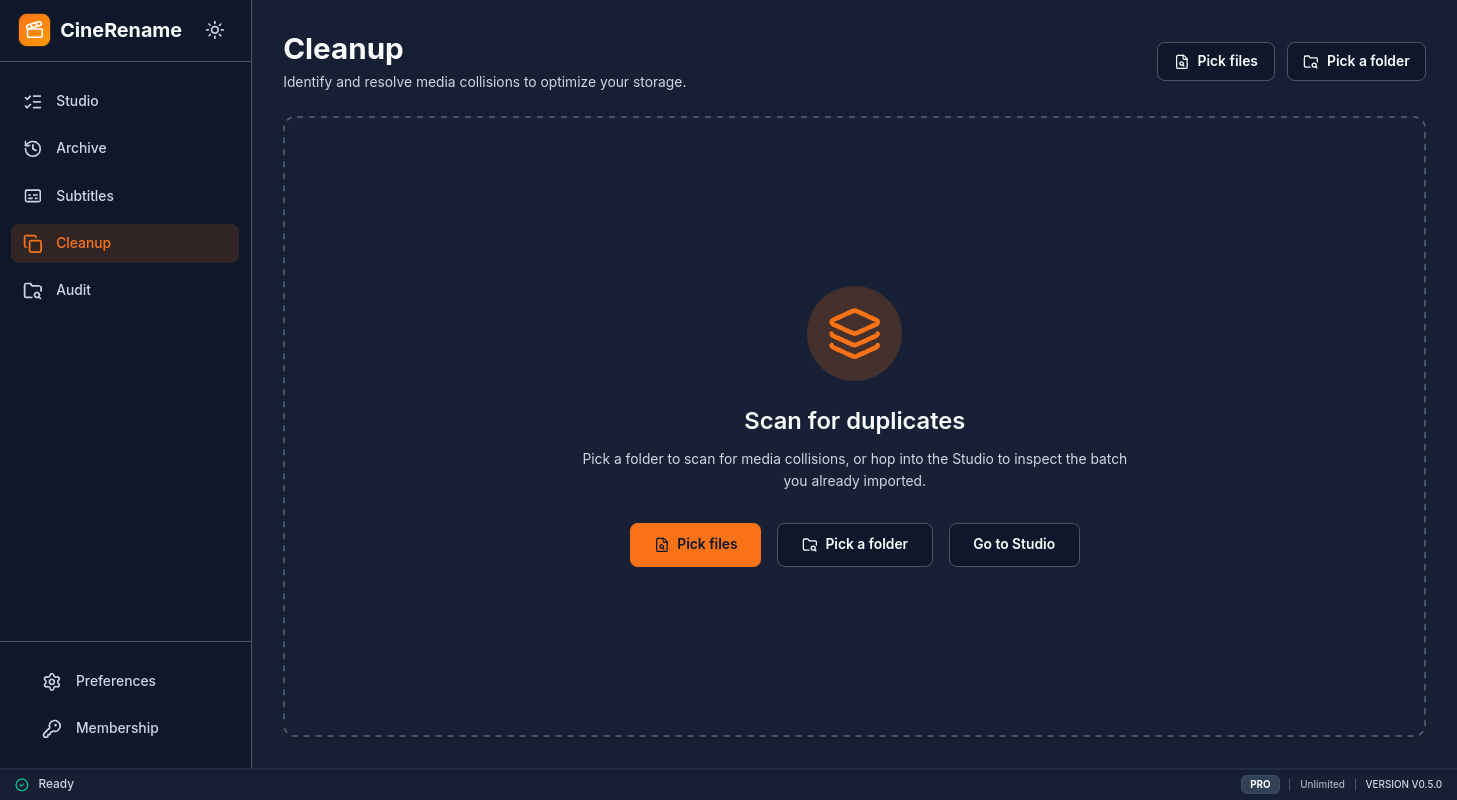
The Duplicates module scans your library to spot multiple copies of the same movie or episode, and helps you free up space by keeping only the best version.
How it works
- You point to a folder (or several).
- CineRename indexes all video files, calculates a quality score, and groups them by media identity (title + year for movies, series + season + episode for series).
- The result is displayed by clusters: one cluster = multiple files pointing to the same content.
The quality score
Each file receives a score based on:
- Resolution — 4K > 1440p > 1080p > 720p > 480p
- Codec — HEVC/AV1 (efficiency) with penalty for older codecs
- Source — BluRay > WEBRip > HDTV > DVDRip
- Bitrate — bonus for high bitrates at equal resolution
- Audio — DTS-HD MA / TrueHD > DTS / DD+ > AC3 / AAC
- Size — to break ties at equal technical quality
The file with the highest score is marked Keep, the others Candidates for deletion.
No automatic deletion
No file is ever deleted without your explicit consent. The module only proposes.
Context menu
On each row of the cluster, right-click opens:
- Open location — Native Finder / Explorer / Files manager
- Play video — launches your default player
- Force keep — marks this file as "to keep" (overrides scoring)
- Force delete — marks for deletion
- Exclude from cluster — if CineRename incorrectly grouped it
Keyboard shortcut
| Action | Windows / Linux | macOS |
|---|---|---|
| Scan the current Studio batch | Ctrl + F | Cmd + F |
Batch deletion
Once your decisions are made on all clusters, the Delete marked button:
- Asks for a final confirmation
- Moves the files to the system trash (recoverable)
- Logs the operation in the History (to undo)
Attention for NAS users
Deletion goes through the OS trash. If the Network Trash (SMB/CIFS) is not enabled on your Synology or QNAP, files will be permanently deleted. Make sure to enable the "Enable Trash" option on your NAS shared folder before using batch deletion.
Best practices
- Always rename first — otherwise CineRename struggles to match
MovieX.1080p.x264-GROUP.mkvwithMovieX.4k.HDR.mkvbecause the names don't look alike. - Run a dry-run first — explore the clusters, tweak the overrides, and only then delete.
- Check multiple editions — for movies, "Director's Cut", "Extended", "Theatrical" are not considered duplicates if explicitly named.
Known limitations
- For multi-discs (a movie split into
Movie - cd1.mkv+Movie - cd2.mkv), CineRename groups them correctly only if thecd1/cd2orpart1/part2convention is respected. - For mixed archives (zips containing multiple versions), you must first extract or use the Studio to normalize them.